For psychology students in West Bengal, the journey from university lectures to professional practice is both exciting and overwhelming. As you complete your undergraduate or postgraduate studies, you are faced with a critical career divergence: should you specialize in clinical psychology or counselling psychology?
Choosing the right specialization dictates the trajectory of your entire career, influencing the types of clients you will see, the diagnostic tools you will use, and the specific licensing bodies (such as the Rehabilitation Council of India, or RCI) you will report to.
If you are currently evaluating your options for a psychology internship Kolkata, understanding the stark clinical differences between these two domains is essential. Here is a clinician’s guide to help you make an informed decision for your professional future.
The Fundamental Clinical Difference
While both clinical and counselling psychologists aim to alleviate emotional distress and improve mental well-being, their foundational scopes of practice differ significantly in pathology and intervention.
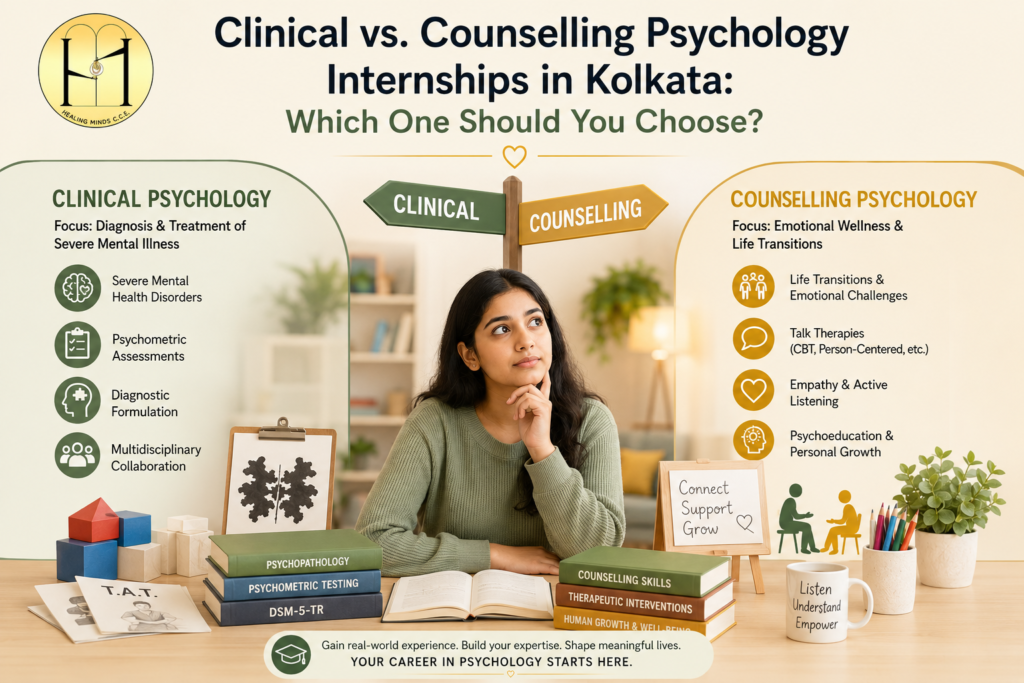
Clinical Psychology: Pathology and Severe Mental Illness
Clinical psychology heavily emphasizes the diagnosis, assessment, and treatment of severe psychopathology and complex psychiatric disorders. Clinical psychologists are trained to manage conditions that significantly impair a patient’s reality testing and daily functioning, such as:
- Schizophrenia and other psychotic spectrum disorders.
- Bipolar disorder and severe clinical depression.
- Severe personality disorders (e.g., Borderline, Antisocial).
A clinical psychologist relies heavily on standardized psychometric testing (IQ, projective tests, and personality inventories) to aid in psychiatric diagnosis.
Counselling Psychology: Life Transitions and Emotional Wellness
Clinical psychology heavily emphasizes the diagnosis, assessment, and treatment of severe psychopathology and complex psychiatric disorders, addressing conditions classified by global authorities like the World Health Organization (WHO). Clinical psychologists are trained to manage conditions that significantly impair a patient’s reality testing and daily functioning, such as:
- Adjustment disorders and life transitions (e.g., divorce, grief, career changes).
- Mild to moderate anxiety and depressive symptoms.
- Relationship conflicts and family dynamics.
- Identity issues and stress management.
The focus here is heavily placed on the therapeutic alliance and utilizing talk therapies, such as Cognitive Behavioural Therapy (CBT) or Client-Centered Therapy, to foster emotional resilience.
What to Expect from a Psychology Internship in Kolkata
When applying for internships, the curriculum should directly mirror the specialization you wish to pursue.
In a Clinical Psychology Internship
A rigorous clinical internship will place you in environments where you handle high-acuity cases. Your training will heavily prioritize:
- Psychometric Assessments: Mastering the administration and scoring of complex tools like the Rorschach Inkblot Test, Thematic Apperception Test (T.A.T), and detailed clinical inventories.
- Diagnostic Formulation: Learning to navigate the DSM-5-TR or ICD-11 to formulate accurate diagnostic impressions based on Mental Status Examinations (MSE).
- Multidisciplinary Collaboration: Shadowing senior clinical psychologists and collaborating with psychiatrists for medication-assisted treatment plans.
In a Counselling Psychology Internship
A counselling internship focuses on the mechanics of the therapeutic process. Expect your training to highlight:
- Therapeutic Modalities: Supervised practice in specific interventions like CBT, Dialectical Behaviour Therapy (DBT), or specialized non-verbal techniques like Play and Art Therapy for children.
- Active Listening and Empathy Building: Refining the micro-skills of counseling, including unconditional positive regard, boundary setting, and ethical communication.
- Psychoeducation: Learning how to educate clients on stress management, emotional regulation, and cognitive restructuring.
- Diagnostic Formulation: Learning to navigate the DSM-5-TR or ICD-11 to formulate accurate diagnostic impressions based on Mental Status Examinations (MSE).
How to Choose the Right Path for Your Career
Your choice ultimately depends on your clinical temperament. Ask yourself:
- Are you drawn to diagnostics? If you are fascinated by the intricacies of neurodevelopmental disorders, severe trauma, and complex psychometric scoring, clinical psychology is your domain.
- Are you drawn to emotional healing? If you prefer working collaboratively with clients to navigate their daily emotional hurdles, relationship dynamics, and personal growth, counselling psychology is the better fit.
Gain Comprehensive Hands-On Experience at Healing Minds CCE
Regardless of the path you choose, textbook knowledge alone will not prepare you for the consulting room. Experiential learning under licensed supervision is non-negotiable.
At Healing Minds CCE, we provide comprehensive, hands-on exposure to both ends of the psychological spectrum. To understand the specific therapeutic modalities our interns learn to apply in real-world scenarios, explore our Evidence-Based Psychotherapy Services.
If you are a driven psychology student seeking a structured, rigorous psychology internship Kolkata, we are here to mentor you.
Take the definitive step toward your clinical career. Apply for the Healing Minds CCE Internship Program today and gain the practical skills required to thrive in the mental health field.
Author Bio: Reviewed and approved by the Clinical Psychology Team at Healing Minds: Centre for Counselling and Education (C.C.E.). Our practitioners hold valid clinical licenses and specialize in psychometric assessments, advanced therapeutic interventions, and professional psychological supervision in West Bengal.