In today’s fast-paced corporate environment—especially for professionals commuting daily to bustling business hubs like Salt Lake and New Town—a certain level of stress is expected. We normalize late nights, tight deadlines, and endless meetings. In fact, recent data reveals that an alarming 47% of Indian corporate professionals report experiencing severe job stress.
However, as clinical practitioners, we often see clients who categorize their profound mental exhaustion as “just another busy week.” There is a critical clinical distinction between daily occupational stress and true professional burnout.
If you find yourself dreading the workday before it even begins, it is essential to recognize the signs of burnout before it takes a severe toll on your physical and psychological health.
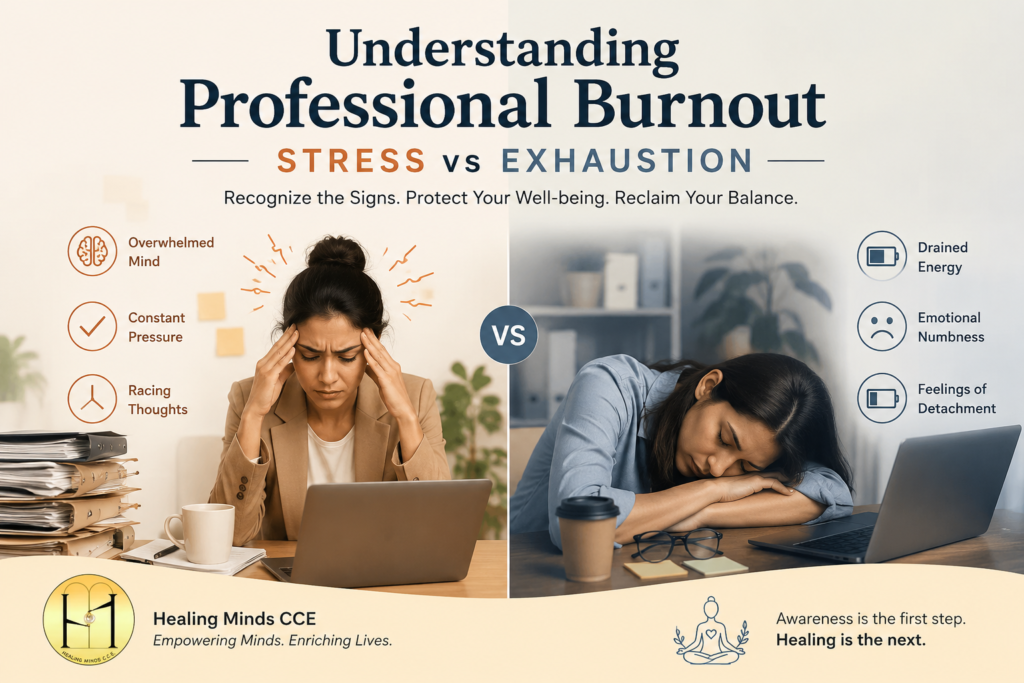
The Clinical Difference: Stress vs. Burnout
To effectively address your mental health, you must first understand what you are experiencing.
Stress is characterized by over-engagement. When you are stressed, your nervous system is in a state of hyper-arousal. Your emotions are over-reactive, you feel a sense of urgency, and your primary physical symptom is a loss of energy. You likely believe that if you could just get everything under control, you would feel better.
Burnout, on the other hand, is characterized by disengagement. It is a state of emotional, physical, and mental exhaustion caused by excessive and prolonged stress. In burnout, your nervous system drops into hypo-arousal. Your emotions become blunted, you feel helpless, and your primary symptom is a loss of motivation and hope.
Recognizing the Core Signs of Burnout
Burnout does not happen overnight; it is a gradual descent. According to the World Health Organization (WHO), which officially recognizes burnout as an occupational phenomenon, it is characterized by three distinct dimensions.
Here are the primary signs of burnout you should not ignore:
1. Profound Energy Depletion and Exhaustion
This goes beyond needing a weekend to catch up on sleep. It is a bone-deep fatigue where you feel drained of emotional and physical energy from the moment you wake up. You may experience chronic headaches, gastrointestinal issues, or a weakened immune system.
2. Increased Mental Distance and Cynicism (Depersonalization)
Do you find yourself feeling increasingly resentful toward your job, colleagues, or clients? A hallmark sign of burnout is developing a cynical or negative attitude toward your workplace. You might isolate yourself, skip non-mandatory meetings, or feel completely detached from the outcomes of your projects.
3. Reduced Professional Efficacy
Despite working the same hours (or more), your productivity drops. You might find it impossible to concentrate, struggle with basic decision-making, or feel a profound sense of inadequacy and lack of accomplishment. Tasks that once took an hour now take three.
How Clinical Therapy Can Help Reverse Burnout
Recovering from professional burnout requires more than just taking a vacation; it requires a systemic change in how you process stress, set boundaries, and engage with your work.
Through structured, evidence-based interventions like Cognitive Behavioural Therapy (CBT), we help professionals identify the cognitive distortions driving their overwork, rebuild healthy boundaries, and restore their nervous system’s baseline. Therapy provides the tools to transition from surviving your workweek to actively thriving in your career.
Seek Professional Support in Kolkata
You do not have to navigate career-threatening exhaustion on your own. If you recognize these symptoms in yourself, seeking professional intervention is a vital step toward reclaiming your energy and focus.
Explore our Counselling and Psychotherapy Services to understand the clinical approaches we use to treat occupational burnout and chronic stress.
If you are ready to begin your recovery journey, book a consultation session with our clinical team at our South Kolkata centre today.
Author Bio: Reviewed and approved by the Clinical Psychology Team at Healing Minds: Centre for Counselling and Education (C.C.E.). Our licensed practitioners specialize in workplace stress management, adult psychotherapy, and evidence-based therapeutic interventions in Kolkata.